
5th Sunday of Lent
March 23, 2026
Gospel Reflection
John 11:1-45
Jesus knows his hour is approaching. He has already announced this on several occasions to his disciples (cf. Jn 8:20; 13:33-38). Despite these warnings, Jesus realizes it will be hard for them to understand what is about to happen. So, to strengthen the apostles’ faith, when news of the illness of his friend Lazarus arrives, He decides to wait. And He gives a reason for this which, at first glance, is not obvious: This illness does not lead to death. It is for the glory of God, so that the Son of God may be glorified through it (Jn 11:4).
Our Lord is not insensitive to the suffering of Lazarus, nor to that of his sisters. On the contrary, we see Him crying at the tomb of his friend after Martha and Mary open their hearts and share their sorrow and pain with Him. Lord, if you had been here, my brother would not have died (Jn 11:21), Martha exclaims. We can intuit that Christ did not come immediately upon receiving the news because He wanted to give a new dimension to their suffering. Martha knew that Lazarus would be restored to life in the resurrection on the last day (Jn 11:24). But she didn’t expect to enjoy her brother’s company again in this life. “Jesus could have avoided the death of his friend Lazarus, but he wanted to share in our suffering for the death of people dear to us, and above all, he wanted to show God’s dominion over death.
On arriving in Bethany, the first “miracle” Jesus works is, in a certain sense, helping Martha escape from the “tomb” her thoughts have trapped her in. He doesn’t reproach her for a single tear she has shed over her brother’s death. In that moment of deep sorrow, Jesus wants to strengthen her hope. I am the resurrection and the life. Whoever believes in me, though he die, yet shall he live, and everyone who lives and believes in me shall never die. Do you believe this? (Jn 11:25-26). And Martha, despite her great sorrow and confusion, answers: Yes, Lord; I believe that you are the Christ, the Son of God, who is coming into the world. (Jn 11:27). In the midst of her weeping, Martha continues to have faith. Regardless of her brother now being dead, she believes that whoever is with Christ will not die. Her sadness over Lazarus’s death and her lack of understanding over why her Friend hadn’t come sooner doesn’t prevent Martha from recognizing that Jesus is the Messiah, the one who gives meaning to her own life.
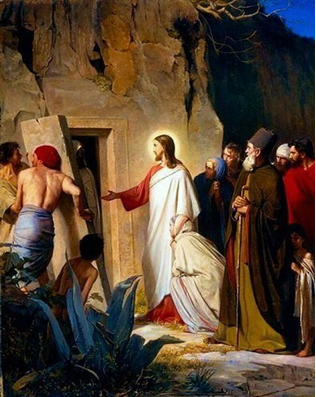
When Jesus arrived at the tomb, He asked those present to remove the stone. But Martha protested: by this time there will be an odour, for he has been dead four days (Jn 11:39). Our Lord reminds her of his recent conversation with her: Did I not tell you that if you believed you would see the glory of God? (Jn 11:40). Then they removed the stone and Jesus, after addressing his Father, cried out with a loud voice: “Lazarus, come out!” The man who had died came out, his hands and feet bound with linen strips, and his face wrapped with a cloth (Jn 11:43-44).
Christ refuses to accept the tombs we have sometimes built for ourselves, with our mistakes and confusions. He invites us to come out of the tomb, like Lazarus, and embrace the life He is offering us. “He invites us, almost orders us, to come out of the tomb in which our sins have buried us. He calls us insistently to come out of the darkness of that prison in which we are enclosed, content with a false, selfish and mediocre life.” [4] But He also counts on our freedom to accept this call or not. Jesus does not force us to get up. He holds out his hand to us and waits for us to take it. “Lazarus rose because he heard the voice of God and immediately wanted to get out of the situation he was in. If he hadn’t wanted to move, he would have died again. A sincere resolution: to always have faith in God; to always hope in God; to always love God... who never abandons us.” [5]
[1] Francis, Angelus, 29 March 2020.
[2] Saint Josemaría, Friends of God, no. 221.
[3] Saint Josemaría, The Forge, no. 159.
[4] Francis, Angelus, 6 April 2014.