
21st Sunday in Ordinary Time
August 18, 2026
Gospel Reflection
Matthew 16:13-20
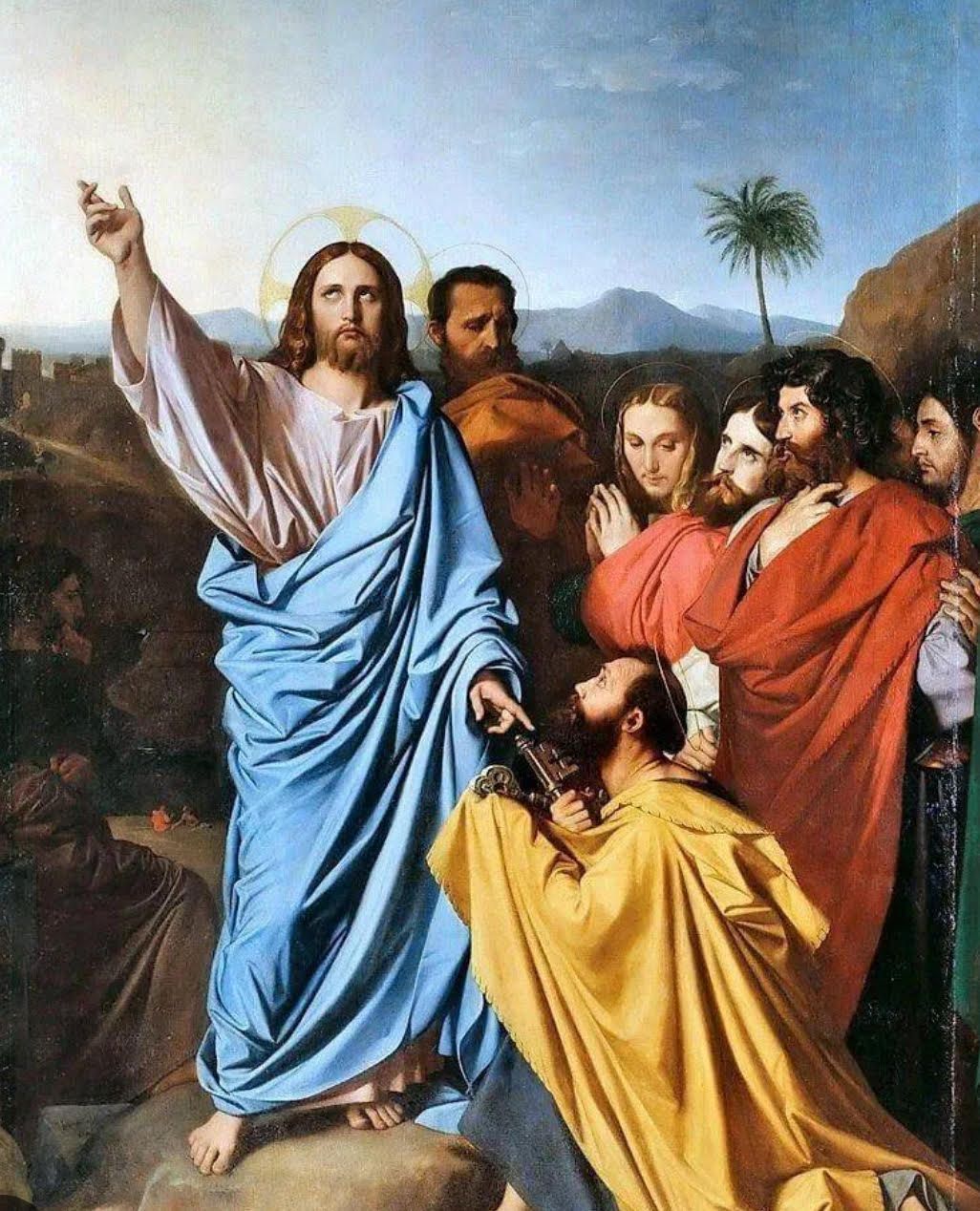
I will give you the keys of the kingdom of heaven, and whatever you bind on earth will be bound in heaven.
The keys signify power: I will place on his shoulder the key of the house of David, we read in today’s First Reading (Is 22:19-23), the reference being to Eliakim, the steward of the royal palace. The power promised to Peter, which will be conferred on him after the resurrection (cf John 21:15-18), is immensely superior to this. He is not given the keys of an earthly kingdom, but of the Kingdom of Heaven, that kingdom which is not of this world but which is nurtured here and which will last forever. Peter has the power to bind and loose, that is, to absolve or to condemn, to gather or to exclude. This power is so great that whatever he decides on earth will be ratified in heaven. To exercise it, he counts on a special help from the Holy Spirit.
These great spiritual powers are given to Peter for the good of the Church, and since the Church has to last until the end of time, these powers are handed down throughout history to those who take Peter’s place. The Church’s Magisterium has always stressed this point. In the Second Vatican Council’s dogmatic Constitution on the Church we read: This sacred synod; following in the steps of the First Vatican Council teaches and declares with it that Jesus Christ, the eternal pastor... put Peter at the head of the other apostles, and in him He set up a lasting and visible source and foundation of the unity both of faith and of communion. This teaching concerning the institution, the permanence, the nature and the import of the sacred primacy of the Roman Pontiff and his infallible teaching office the sacred synod proposes anew to be firmly believed by all the faithful (Second Vatican Council, Lumen gentium, 18). The Roman Pontiff is the successor of Peter; united to him we are united to Christ. He is his Vicar here on earth, the one who takes his place.
An ancient formula sums up in a few words all the teaching about the Roman Pontiff: Ubi Petrus, ibi Ecclesia, ibi Deus (St Ambrose, Commentary on Psalm 12, 40, 30). Where Peter is, there is the Church, there too is God. The Roman Pontiff - says the Second Vatican Council - as the successor of Peter, is the perpetual and visible source and foundation of the unity both of the bishops and of the whole company of the faithful (Second Vatican Council, Lumen gentium, 23). And what would become of this unity if there were not one head over all the Church, to bless it and care for it, and to unite all its members in the profession of one faith and join them together in the bond of charity and of union? (Gregory XVI, Commissum divinitus, 15 June 1835). Unity would be smashed into a thousand pieces and we would wander like scattered sheep, without a sure faith in which to believe, without a clear path to follow.
We want to be with Peter, because with him we have the Church, with him we have Christ; and without him we will not find God. And because we love Christ we love the Pope - with the same charity. And since we are attentive to Jesus, to his desires, to his actions, to his entire life, in the same way we are united to the Roman Pontiff in even the smallest details: we love him above all for the One he represents and of whom he is the instrument You must love, venerate, pray and mortify yourself for the Pope, and do so with greater affection each day. For he is the foundation-stone of the Church and; throughout the centuries, right to the end of time, he carries out among men that task of sanctifying and governing which Jesus entrusted to Peter (J. Escrivá, The Forge, 134).
In the Acts of the Apostles we see clear evidence of the love and devotion the first Christians had for Peter: they even carried out the sick into the streets, and laid them on beds and pallets, that as Peter came by at least his shadow might fall on some of them (Acts 5:15). They were happy to make do with the shadow of Peter. They knew well that very close to him there was Christ!