
4th Sunday in Ordinary Time
January 30, 2026
Gospel Reflection
Matthew 5:1-12a
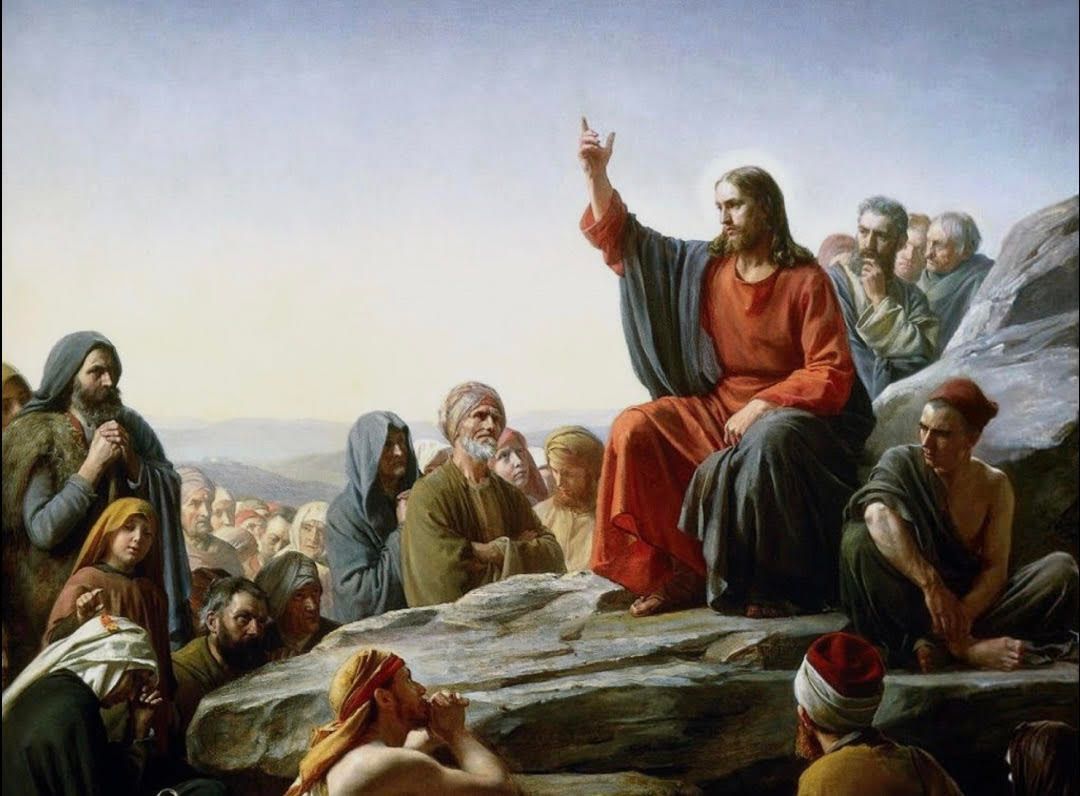
St. Matthew describes for us what was likely to be a frequent way of teaching employed by Our Lord. “He went up the hill.” Along Lake Genesareth there were the rolling hills typical of some parts of Galilee. Because of the large numbers of people that would gather, Jesus had to take some special measures to be able to speak to them and be seen. Just as on some occasions he would speak from the raised vantage point of Peter’s boat, set off a short distance from the shore, here he used the raised platform provided by a gentle slope. There would have been a certain solemnity about these occasions. In retrospect the disciples might have recalled Moses bringing down the words of God from Mount Sinai. But there must have also been a great familiarity. We are told, for instance, that Jesus “sat down.” And whereas no one dared accompany Moses on his visits to the summit of Sinai, here Jesus was surrounded by people eager to hear him and experiencing a real intimacy with him.
What he taught was often framed in the language of a parable that engaged even the superficial listener or the stubborn critic. At other times the teachings were more direct, probably because his hearers were largely the more sincere types and those who already considered themselves his disciples. The words of today’s Gospel are an example of such teachings. They are known to us as the Beatitudes. Here Jesus phrased things in a rhythmic or poetic form, matching virtuous attitudes and dispositions with promised blessings coming from God. More accurately than “Happy are…” is the translation “Blessed are…” From there comes the expression “The Beatitudes” ( beatus = blessed in Latin).
These sayings of Our Lord, which he perhaps repeated on different occasions and with varying groups of disciples, are central to the Gospel message of Our Lord and they form a program for Christian life. Notice that Jesus firstly says: “Blessed are the poor in spirit.” The meaning of this has often been explained as a detachment from material things, and even from self. So we learn of the “spirit of poverty” and humility and are encouraged to grow in these dispositions by the promise of “the kingdom of heaven” (i.e. God Himself). On the contrary, if we are caught up and absorbed by the acquisition and possession of many things, putting our hearts and minds there so much that we seldom think of anything else, then we can hardly expect to find God and to enjoy his company. We even put ourselves in danger of losing him forever. Similarly, those who are vain, arrogant or self-absorbed, or who seek to achieve happiness through their own hands alone, miss the true meaning and perspective of life. That meaning lies in love – love of God and others. The love of God grows in the measure in which we acknowledge what we have received from Him and what he – far above all created things – is in Himself. Another “beatitude” urge us to be “gentle” or “meek” (in the way Our Lord was). Meekness is not weakness but strength – the strength to control anger and therefore not to fault through excess even in the face of injustice. Our Lord did not act in a domineering way even though He had the power to conquer the opponent. He was strong and firm but he did not bully or abuse. This is Christian meekness. Of the meek Jesus says: “They shall have the earth for their heritage.” How do we behave as parents, as supervisors, as neighbours, as friends, as citizens fighting for a just cause?
The Beatitudes refer to Moses and the Commandments. In this regard, Pope Leo the Great had to say: “And so it was that he who had spoken to Moses spoke also to the apostles. Writing in the hearts of his disciples, the swift hand of the Word composed the ordinances of the new covenant. And this was not done as formerly, in the midst of dense clouds, amid terrifying sounds and lightning, so that the people were frightened away from approaching the mountain. Instead, there was a tranquil discourse which clearly reached the ears of all who stood nearby so that the harshness of the law might be softened by the gentleness of grace, and the spirit of adoption might dispel the terror of slavery”
In their originality and profundity the Beatitudes are a sort of self- portrait of Christ, and for this very reason are invitations to discipleship and to communion of life with Christ. So as we listen to or read each of them we can carry on our own examination of conscience to see if we try to grow in these Christian attitudes day by day.