
4th Sunday of Easter
April 24, 2026
Gospel Reflection
John 10:14
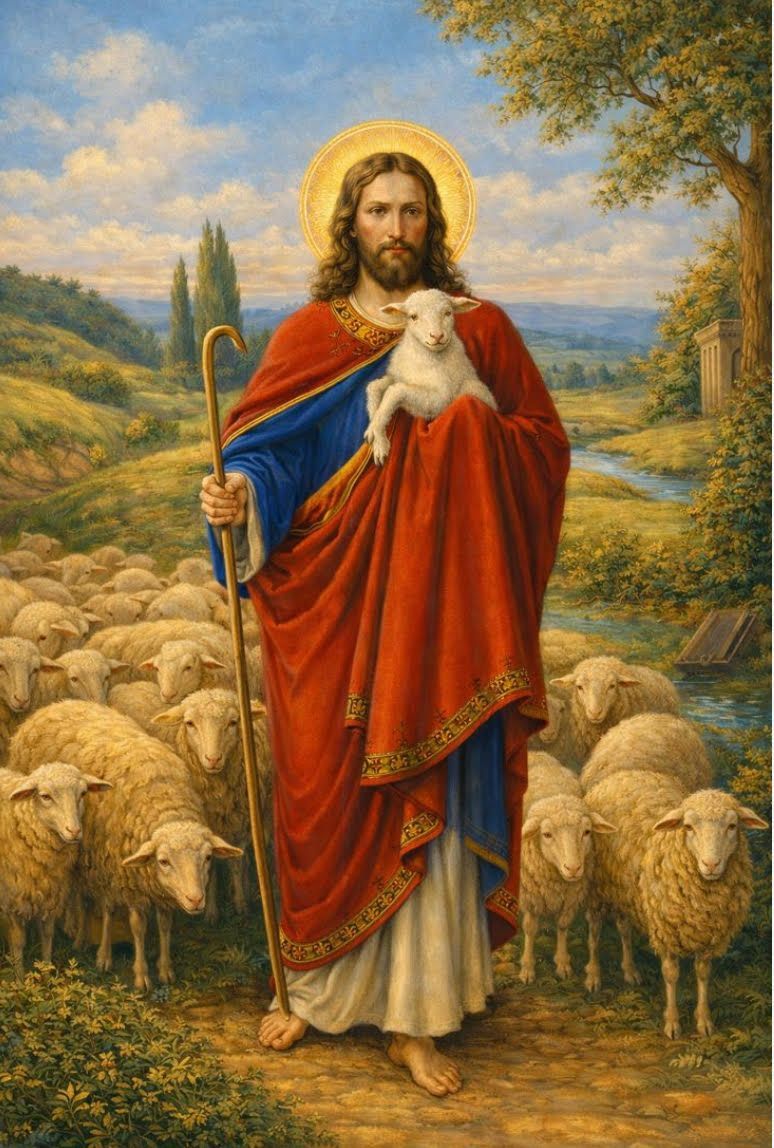
“He was bearing our faults in his own body on the cross”, says St. Peter, “so that we might die to our faults and live for holiness; through his wounds you have been healed. You had gone astray like sheep but now you have come back to the shepherd and guardian of your souls.” Peter did not see Jesus die on the cross. He had been too frightened and despondent to make his way to Calvary, as Mary, John, and several of the women had done. But now, many years later, on writing these words of encouragement to his fellow Christians of the 1st century, he showed how much he himself had meditated on what Christ had done for him and for all men and women. He was testifying to his own experience as one who had been taught, firmly but lovingly corrected, and many times forgiven by Jesus. He knew that the words of the Saviour describing himself as “the Good Shepherd” were not said falsely or as mere poetry. Jesus had always shown the attitude of one who was ready “to lay down his life for his friends” (John 15:13) and who finally did.
As the Lord himself had noted, there was a difference between the shepherds of his times and those men who were simply hirelings. The shepherd’s flock was his own. The hireling’s flock were someone else’s. As a result most shepherds treasured their sheep and learned to identify each one of them. They felt the loss of any one of them. Hirelings, by and large, were far less concerned about losses. God is the ultimate Shepherd who bears an intimate relationship with his flock, the human family. “To him the gatekeeper opens; the sheep hear his voice, and he calls his own sheep by name and leads them out. When he has brought out all his own, he goes before them, and the sheep follow him.” God did this in a tangible way by Himself becoming a man, a teacher with a human voice, a friend with a human heart, a living example of what we ought to aspire to as human beings. He came into our world, a world He had created for us, to bring us to perfection, to a share in his own holiness. Such is the pasture Jesus refers to— it is holiness, it is, finally, the happiness of heaven and eternal life in God.
Christ Our Lord established his Church to lead us to this pasture of holiness and happiness in unending love. Within the Church he calls some to act as shepherds in his name. These are his ministers, his bishops, priests and deacons, who are summoned by a personal vocation to serve others in this way. Because the response to this calling requires God’s grace and a free acceptance by individual persons, both Jesus and the Church urge us to “pray [to] the Lord of the harvest to send out labourers into his harvest” (Luke 10:2). We do so, in a special way, on this World Day of Prayer for Vocations.
All of us in the Church, clergy, members of religious orders and congregations and lay people are called to be shepherds for others in one way or another. Parenting, friendship and work based relationships can all be occasions for being good shepherds. At the same time we must also remember that all of us, laity and clergy and religious, are called to be good sheep, letting ourselves be helped and guided by those who sincerely do so in the name of Christ. Ultimately, there should be that desire to let our lives be deeply influenced by a loving entrustment to Jesus. Pope John Paul II once said: “Make a particular effort to seek Jesus and attain a deep personal faith which influences and directs your whole life; but above all may your commitments and plans consist in loving Jesus, with a sincere, genuine, personal love. He should be your friend and support along the way of life. He alone has the words of eternal life”
(Address January 30, 1979).